


The event will take place on Thursday 26 November, at 17:00 GMT (19:00 Athens time)
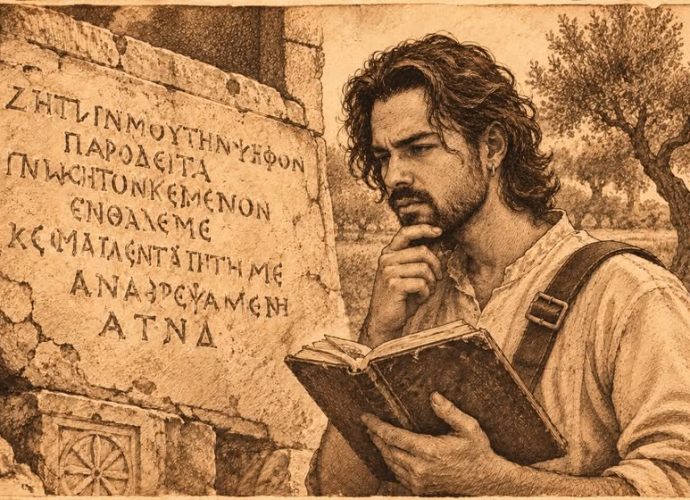
Nearly 2,000 years ago, in the ancient city of Pharae in Messenia (modern Kalamata), a funerary inscription was erected bearing an enigmatic number: 1354. Rather than revealing the name of the deceased, the inscription challenges the passer-by to discover it by “seeking the number.” Despite more than a century of scholarly investigation, this remarkable riddle has remained unsolved. This paper invites the audience to follow the process of deciphering the puzzle step by step, examining the clues that may hold the key to its solution. Drawing on the ancient practice of isopsephy (the assignment of numerical values to Greek letters), acrostic reading, and hints embedded within the text itself, it proposes a possible identification of the otherwise anonymous deceased. The paper also explores whether the structure of the riddle reflects Pythagorean concepts of numerical relationships, the harmony of opposites, and the cycle of life and death. Beyond the challenge of solving an ancient mystery, this investigation offers a window into the intellectual, religious, and cultural milieu of the southern Peloponnese during the Roman Imperial period, revealing how numbers, language, and belief could intersect in commemorating the dead..
Our speaker:
Petros Tsagklis is a doctoral researcher at the University of Nottingham and the recipient of a four-year Midlands4Cities (AHRC) Doctoral Studentship. A native of Laconia, Greece, he holds a BA with Honours in History and Archaeology from the National and Kapodistrian University of Athens and an MA in Ancient Mediterranean History and Archaeology from the University of Crete. His doctoral research examines the League of the Free Laconians (Koinon of the Eleutherolakones), with a particular focus on its political, social, and cultural development during the Roman period. His wider research interests encompass the history and archaeology of ancient Laconia, warfare, trade and exchange networks, and social and funerary practices in the ancient Mediterranean. He is the author of two monographs and has published scholarly articles in peer-reviewed academic journals. He is a member of the Centre for Spartan and Peloponnesian Studies at the University of Nottingham and the Society for Laconian Studies in Athens.
The event is free to attend but you must register in advance via this link: https://events.teams.microsoft.com/event/e4f8bc21-14bf-40c1-b8fb-3e3cec8befa3@67bda7ee-fd80-41ef-ac91-358418290a1e
The talk will also be livestreamed via https://vachosradio.gr/
Comments are closed, but trackbacks and pingbacks are open.