



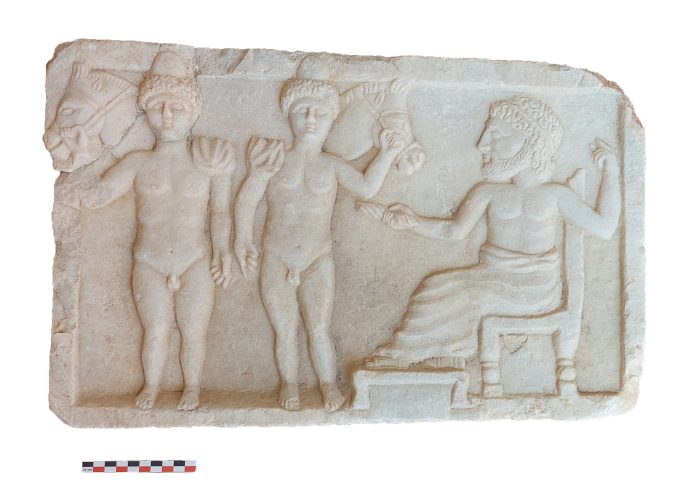
“The cult of the Dioskouroi in the Roman Peloponnese – The evidence from votive reliefs”.
We are delighted to invite you to the upcoming CSPS SPECS ‘BEING PELOPONNESIAN’ webinar, featuring Dr Aineias Kapouranis and his talk, “The cult of the Dioskouroi in the Roman Peloponnese – The evidence from votive reliefs”.
Summary:
Among the major cults of the Peloponnese, that of the Dioskouroi retained enduring prominence well into the Roman period. During this time, the Tyndaridae – more commonly referred to as Castor and Pollux – continued to be venerated as protectors of young future hoplites, athletes, and sailors. Although Sparta remained their principal cult centre, where they ranked among the city’s foremost gods and heroes, evidence for their worship is also attested at Corinth, Epidauros, and Tegea.
The multifaceted nature of their cult is reflected in the stone votive reliefs dedicated to them, which preserve a consistent visual koine: the twins appear invariably as a pair, either alone or accompanied by their horses. Yet the diversity of iconographic types and stylistic approaches raises questions regarding the semantic content of these images, the evolution of typological schemes in relation to earlier periods, and the potential identification of local workshops.
This talk examines eight votive reliefs from the aforementioned cities through iconographic and stylistic comparison in order to assess the continued vitality of the Dioskouroi’s cult in the Roman Peloponnese. Particular attention is given to typological evaluation, compositional schemes, and workshop practices. The reliefs illuminate processes of cultural continuity and civic self-definition, demonstrating how traditional cult imagery was adapted to the political and social realities of Roman rule.
Dr Aeneias Kapouranis is a classical archaeologist
Dr Aeneias Kapouranis is a classical archaeologist who received his PhD from the National and Kapodistrian University of Athens in 2023. His dissertation, The Votive Reliefs of the Peloponnese: Iconography, Interpretation and Meaning from the Archaic to the Roman Period, offers a comprehensive examination of votive reliefs and their religious contexts across time. The study is currently being prepared for publication as a monograph under the title “Cults and Reliefs of the Peloponnese: A Continuous Dialogue”.
Dr Kapouranis has published in Acta Archaeologica on the iconography of Artemis in fourth‑century BC votive reliefs from Tegea, and in Themes of Archaeology on the sculptor Pasiteles. He has also contributed book reviews to the American Journal of Archaeology and the Bryn Mawr Classical Review. In 2024, he presented part of his research at the 4th International Scientific Meeting Archaeological Work in the Peloponnese (AWOP 4). His research focuses on Greek cult practice and votive iconography — topics that resonate closely with this webinar’s discussion of the Dioskouroi and their cult in the Roman Peloponnese.
Join us online on Thursday 30 April at 17:00 BST via MS Teams. The event is free and open to all; please register in advance: https://events.teams.microsoft.com/event/f13e23bc-41bf-4bd7-be5d-f082b17c2d8c@67bda7ee-fd80-41ef-ac91-358418290a1e
Comments are closed, but trackbacks and pingbacks are open.